

the eve of World Telecommunication and Information Society Day, 17/05/2026
The Palestinian Central Bureau of Statistics (PCBS), the Ministry of Telecommunication & Digital Economy, and the Telecommunication Regulatory Authority issue a joint press release on the eve of World Telecommunication and Information Society Day, 17/05/2026.
Digital Lifeline in Palestine: Between Development Challenges and Strengthening Resilience
This year’s World Telecommunication and Information Society Day is observed under the theme "Digital lifelines: Strengthening resilience in a connected world". Telecommunications have evolved beyond a basic service to become a critical enabler of development and survival. Resilient digital infrastructure underpins inclusive digital ecosystems and supports meaningful connectivity, ensuring safe, affordable, and effective internet access for all. Digital resilience, defined as the capacity to withstand, adapt to, and rapidly recover from disruptions, is essential for maintaining essential services and protecting lives and livelihoods.
In this context, the telecommunications and information technology sector serves as a critical enabler of development in Palestine as a whole, and in Gaza Strip in particular. The internet has increasingly become an essential means of communication, a vital channel for survival and dissemination of truth, and a key instrument for strengthening resilience. It also plays an important role in supporting recovery and reconstruction efforts, revitalizing the labour market, and providing a fundamental foundation for economic growth and sustainable development.
Despite the challenges: two-thirds of Gaza Strip remains connected to the Internet.
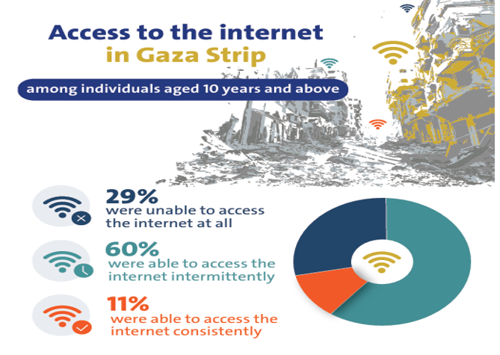
Amid escalating challenges in Gaza Strip, findings of the Labour Force Survey, conducted during September 3rd and October 31st 2025 indicate that approximately 71% of individuals (10 years and above) were able to access the internet at least once (60% reported that they only had intermittent access, while 11% had continuous internet access). In contrast, 29% of individuals reported having no internet at all.
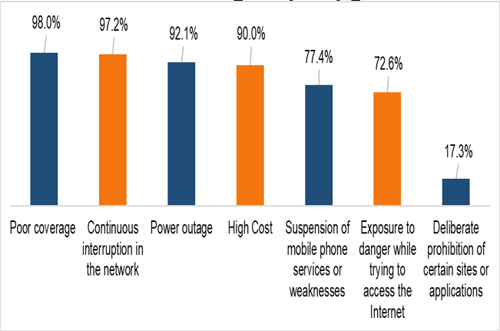
Regarding the challenges faced during internet use, 98% of respondents indicated poor coverage, 97% of respondents reported persistent network disruptions, and 77% experienced interruptions or severe limitations in mobile services that hindered internet access. Notably, 73% reported being exposed to danger while attempting to access the internet, underscoring the extent to which basic digital access has become associated with significant risk.
Percentage of Individuals (10 years and above) Who Faced Difficulties while Using the Internet in Gaza Strip, by Type of Difficulty
Ownership of smartphones constitutes a key tool for digital communication
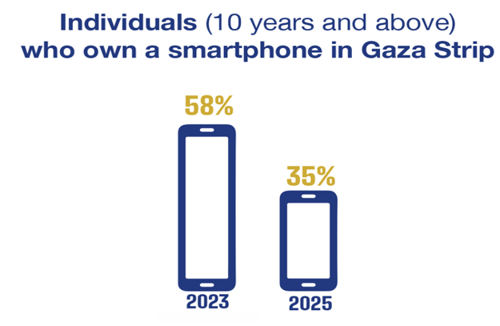
Data from the Labour Force Survey indicate a marked decline in smartphone ownership among individuals (10 years and above) in Gaza Strip, falling from approximately 58% on the eve of the Israeli aggression in 2023 to around 35% during the three months preceding the interview, which was conducted in 2025. In the West Bank, according to Labour Force Survey data for the first quarter of 2026, the percentage reached 86%, further enhancing individuals’ ability to connect and communicate.
Moving towards a more efficient and digitally ready internet ecosystem to support the digital economy
In light of the accelerating global trends toward digital transformation, the development of telecommunications infrastructure has emerged as one of the key pillars for enhancing digital readiness and building a more resilient and sustainable economy.
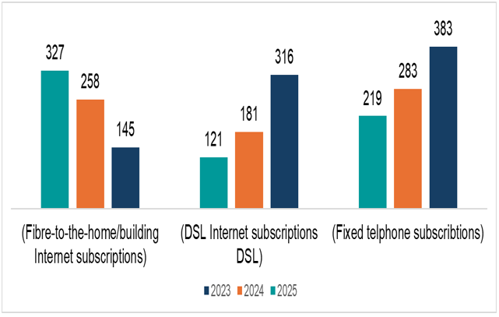
In this context, the telecommunications sector has witnessed a significant shift in subscription patterns over the past three years. According to the Ministry of Telecommunications & Digital Economy’s and the Telecommunication Regulatory Authority’s data; the number of internet subscribers using Fiber to the Home (FTTH) technology increased substantially, reaching 327 thousand subscribers in 2025, representing an increase of 27% compared to 2024. In contrast, the number of internet subscribers using Digital Subscriber Line (DSL) technology has gradually declined.
This transformation reflects a clear shift toward adopting a more efficient and reliable digital infrastructure capable of meeting the growing demand for connectivity and strengthening dependence on digital communication services. It also highlights ongoing efforts to modernize networks and enhance their readiness to support the digital economy and digital government services.
DSL and FTTH Subscriptions in Palestine, (in Thousands)
Despite the challenges, intensified efforts are underway to keep Gaza Strip connected
As part of the Ministry of Telecommunications & Digital Economy’s and the Telecommunication Regulatory Authority’s ongoing efforts to keep Gaza Strip connected despite exceptional challenges, a series of urgent interventions were implemented during 2025 to strengthen the resilience of telecommunications infrastructure. These efforts included activating 12 emergency points to enhance network continuity, in addition to updating the infrastructure database for 94 telecommunications sites, also providing free internet access to 8 shelter centers, aiming to enable citizens to communicate, and access essential services, strengthening community resilience and ensuring the continuity of digital life under the current circumstances.
Given the extensive damage inflicted on Gaza Strip infrastructure, including its telecommunications networks, digital resilience has become a critical factor in maintaining service continuity and ensuring citizens’ access to services, even at the minimum level. Despite these challenges, telecommunications companies have continued to play a vital role in keeping citizens connected under the principle that “connectivity is no longer a choice, but a necessity for protecting vital sectors and support community resilience.” Despite the challenges, telecommunications companies have continued—and continue—to play a vital role in maintaining connectivity for citizens, under the guiding principle that “connectivity continuity is no longer a choice, but a necessity for safeguarding critical sectors and strengthening community resilience”. The telecommunications networks operated by these companies form the backbone of emergency services and humanitarian response, serving as the primary means of communication between relief organizations and the population, given their crucial role in crisis management. This underscores the importance of having a flexible digital infrastructure that can adapt to varying circumstances.
The latest update to mobile network coverage data (April/2026) indicates a continued high coverage rate in the middle of Gaza, reaching approximately 96%. However, coverage rates vary geographically across the governorates. This disparity reflects the challenges related to infrastructure and changing population concentration patterns, necessitating targeted interventions to ensure equitable access to telecommunications services.
Mobile Network Coverage Rate, 2026
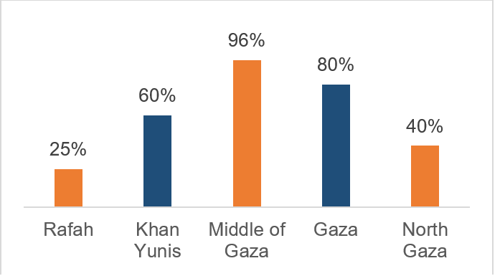
*The data presented correspond to April 2026.
Sharp Decrease in the Value Added of the Information and Communications Activity in Gaza Strip
The quarterly national accounts estimates for 2025, issued by PCBS, revealed an unprecedented sharp decrease in the information and communications activity, particularly in Gaza Strip, which recorded a decline by 88% in the value added at constant prices compared to 2023.
While the value added of this activity for Palestine reached around USD 411 million in 2025, compared to about USD 447 million in 2023 (a decrease of around 8%), the West Bank was the largest contributor of value added, amounting to nearly USD 410 million in 2025, compared to USD 434 million in 2023 (a decline of 6%).
In contrast, Gaza Strip witnessed a sharp decrease, with the value added dropping from USD 13 million in 2023 to around USD 1.6 million in 2025, reflecting a contraction of 88%. This is a highly alarming indicator of the complete paralysis that has affected one of the most vital activities within the knowledge economy in Gaza Strip, resulting from the direct targeting of the telecommunications and information infrastructure during the ongoing Israeli aggression.
The implications of this collapse are not limited to economic losses; they also encompass the erosion of the foundational components of digital development, the widening of the digital divide between Gaza and the world. This situation adversely affects the functionality of the digital ecosystem and reduces its capacity to absorb shocks and recover from disruptions, highlighting that digital connectivity is a critical enabler of resilience and sustained viability.